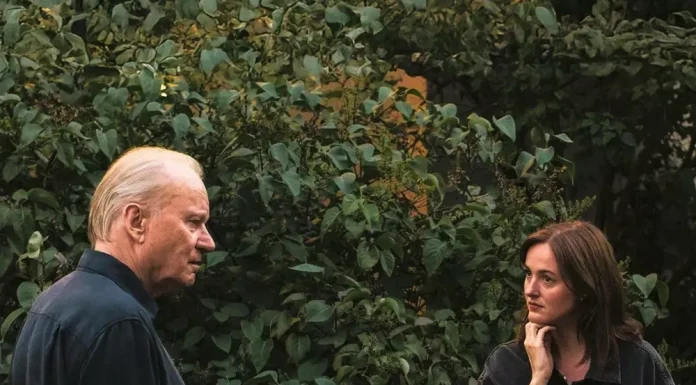

“Sentimental Value” is Joachim Trier’s first film since completing the Oslo trilogy. It features a dramatic shift in narrative sensibilities. It opens with a voiceover about little Nora (Renate Rainsva), a device that seems to promise the viewer something familiar. However, this doesn’t happen; you’re watching a fundamentally different film. Joachim presents at least three equal perspectives on screen, featuring several main characters, each of whom is given a significant chunk of the film’s running time.
It makes sense: the film tells the story of the relationship between a father and his two daughters, whom he left behind after their mother’s death. Now he shows up with a script and asks Nora to play the lead role. The conflict escalates, old resentments resurface, and all this takes place against the backdrop of Nora’s father contemplating selling the family home, which has been home to at least five generations of their family.
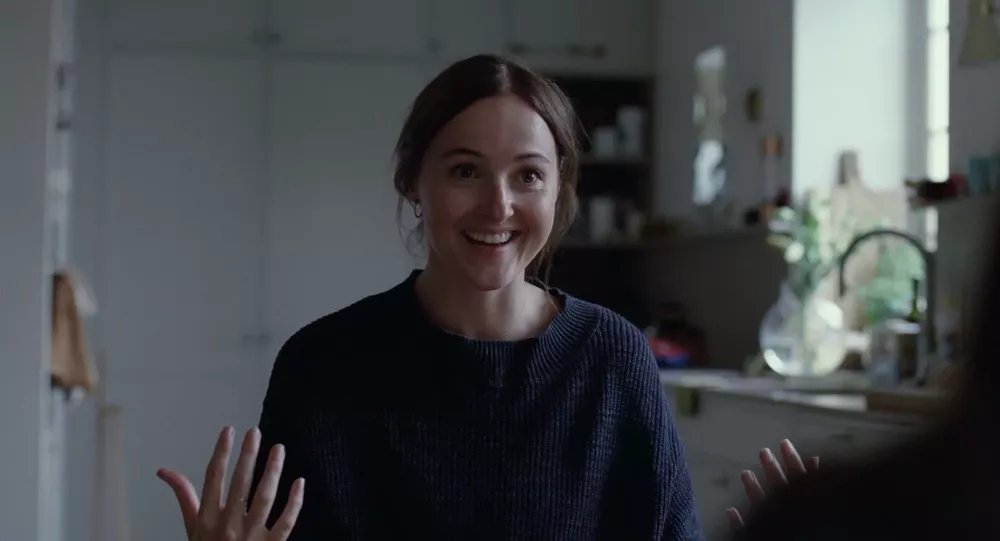
Nominally, the main character is Renate Rainsve’s character, Nora, a lost theater actress who has carried a grudge against her father, Gustav (Stellan Skaasgård), for years and is trying (or not trying) to build a relationship with a colleague. But over the course of the film, Joachim Trier allows you to step into the shoes of both Gustav and Rachel Camp (Elle Fanning) to no lesser extent. By giving the viewer a glimpse behind the scenes of each character’s consciousness, Trier only confuses, as if saying that everyone here deserves sympathy, that everyone’s grievance can be understood… All this happens rather quickly, in a huge amount of dialogue with complex sentences, which is why you simply suffocate and miss the moment when the film turns into a solid family drama with an obvious main character – the house.

While you are trying to grasp someone’s side, to give preference and understand which of the characters is closer to you, Trier simply turns a cube in front of your eyes, in which a small theater stage is located, but he turns it slowly, so that you can look at it from different angles, hear from different sides. Three characters are arguing on stage, but at some point, Trier pulls the cube away from you, and you see scratches, scuffs, chips, and dark stains of unknown origin on its walls. And you understand that the characters are arguing not because they don’t like each other, but because they are sealed in this cube of unknown origin, where many other people have quarreled before. And in this reflection on how to restore broken relationships, Trier reveals several mature, unobvious thoughts, even going so far as to suggest that perhaps, to resolve a conflict, a third character is needed who sees its essence more clearly.
If Trier previously spoke of loneliness, alienation, and misunderstanding through poetic sketches, rhythm, or dialogue, now he reaches a different level in terms of drama: the hero wants to be told, but is shown; the hero wants to be written, but is told, and briefly; the hero wants to hear certain words, but they are spoken to him by someone completely different from whom you expect. This permanent gap in mutual understanding haunts the characters throughout the film, and at some point you truly decide—could this be a curse? What forces make these things work this way?

Then Trier brings us back to the house and covers the Borg family tree. The karmic component appears: by this point, reflections on the meaning of life and an existential crisis also surface… And in general, the key themes of “Oslo, August 31st” and “The Worst Man in the World” are episodically raised again here, but the approach to them is fresh, more detached and mature. But Trier probably addresses those reflections in this film: he proposes, he asks. And can the issue of obsessive thoughts about settling scores with life be resolved by imitating a fictional character? And perhaps these inclinations aren’t your fault; after all, there’s a huge historical burden that lingers with you, passed down with your mother’s milk?
Generally, the Norwegian director doesn’t allow himself to take anyone’s position, once again leaving the viewer the right to reflect on this or that question. But why wasn’t “Sentimental Value,” for example, a production or a play? It has far less air and a lot of dialogue. Trier, a true cinephile, continues to search for his own cinematic language, paying homage to the classics. Here, he resorts to Bergman-esque tools, mixing them with the techniques of French cinema, but presents the world with a plot that becomes an immortal classic, a byword, and eternally relevant.
We grew up with Trier, saw his uneven but vibrant “Reprise,” imbued with the spirit of youth and rebellion. We worried about Anders from Oslo, August 31st, slowly floating through Oslo, feeling the city’s air and its heartbeat. We chose our life’s path with Julia from The Worst Man in the World, worried, laughed, cried, and tried to make a choice.

Trier showed all these characters to the audience without the intention of pleasing: it’s just that the problems that turned out to be so close to us millennials were of great concern to the director himself. And he, doing what he loved, supported us, prompted us, and led us in these reflections. At the same time, he was acquiring the status of a strong director, steadily becoming a festival favorite, and finally, at 51, being the father of two, he reached the point where he could find himself in a new guise. To try to film something more monumental.
And we have no right to deny him this. In “Sentimental Value,” Trier deliberately takes several steps away from the viewer. We can no longer embrace or touch him. But in this way, he merely defines his personal boundaries as an author, leaving us alone with our own space, so that, having traveled a long road with him, we might look not only at the boundaries of our own perception, but find the courage to take a broader view of life, to delve deeper into the state not of our own, but of those around us. And simply allow the thought to enter your head that relationships and life in general are more complicated things, there is no correct optics in thinking about them, but your choice is always yours.
And Joachim Trier in “Sentimental Value” outlines these choices, makes them clearer and again leaves the viewer with a clear head and an inner feeling of freedom, only not there, not in the theater, not at the moment the credits begin, but when he already comes home, lies in bed and, allowing himself to once again play out the plot of the latest film in his head, acquires more and more new meanings.
Text: Dima Kekelidze