
“Jennifer’s Body”
One of the most famous horror films of the 2000s recently experienced a second wave of popularity thanks to social media. This is the story of high school star Jennifer and her quiet friend Needy – hidden behind the standard teenage drama is a bloody parable about power.
After a failed ritual, Jennifer turns into a demon that feeds on boys. She uses her fame, influence, and physical attractiveness to catch new victims. Needy’s friend understands that Jennifer needs to be saved, but the girl seems quite content with her new identity.
The leading roles in this scandalous project were played by Megan Fox and Amanda Seyfried. Karina Kusama’s “Jennifer’s Body” is a film that challenges the traditional view of the “perfect woman.” It’s not just a bloody horror film, it’s something more—a satire on sexual objectification and inflated male expectations.

“Substance”
The most talked-about body horror of recent years, exploring the fear of aging and an industry obsessed with youth. The main character is an actress whose career begins to crumble due to age, and in an attempt to fix everything, she decides on an experiment that promises her a “better version” of herself. But an attempt to maintain control over her body turns into its complete loss. The film literally visualizes the internal conflict between how people want to see you and who you really are. The leading actresses, Demi Moore and Margaret Qualley, perform in such a way that this conflict is literally felt on a physical level. The film is harsh and even repulsive in places, but this is precisely because of this it works so accurately and turns a conversation about beauty into a real horror.

The Neon Demon
Nicolas Winding Refn’s provocative horror film was first shown at the Cannes Film Festival. This story about the fashion industry, where beauty isn’t just an advantage but a resource women are willing to fight for to the bitter end, immediately made it into all the top publications and became one of the most talked-about films of the festival.
Provincial Jessie arrives in Los Angeles with a dream of becoming a model and quickly finds herself immersed in the industry—castings, shoots, and parties take up all her time. Jessie’s naturalness and innocent beauty become a lure for producers and a threat to other models. Elle Fanning stars in the film, and her performance is built on the heroine’s emphasized fragility and inner purity. This makes Jessie’s character both captivating and unsettling—as something too real for the artificial world around her. Gradually, the main character ceases to be perceived as a person, but only as an object that can be appropriated.
“The Neon Demon” has long been dismantled for stills – this project hypnotizes with its perfectly calibrated visual style and explores the line between admiration and consumption.

“Maxine XXX”
The final part of Ti West’s trilogy is the story of the rise of a girl who refuses to be a victim. The action takes place in Hollywood in the 80s, Maxine is an adult film actress who gets a chance to go beyond the industry. She gets the lead role in a horror film, and this is her ticket to a new life. But along with this chance, the past also returns. A private detective begins to uncover the cruel and terrible secrets Maxine tried to leave behind, and against this backdrop, brutal murders occur in the city.
The film places the heroine in an environment where the female body is simultaneously a tool, a commodity, and a source of power. Here, every woman is a potential rival, and success depends on how willing you are to submit to someone else’s rules. But Maxine refuses to play by them and tries to take control of the situation into her own hands.
The film continues the line of “Pearl” and “X”, turning the story of ambition into a dark portrait of obsession with success.

“It Comes for You”
A minimalist, but truly disturbing horror, in which the fear of intimacy takes physical form. The life of the main character Jay changes after a casual affair: she becomes the bearer of a curse, and now she is constantly followed by “something” taking on different guises. Jay tries to understand how to protect herself and who to trust now, but one thing is clear – the pursuit cannot be stopped.
The main difference of the film is the sense of inevitability. The threat isn’t explained or gone—it just keeps coming. “It Comes for You” accurately conveys a girl’s sense of vulnerability and anxiety associated with intimacy. An experience that should be a step toward adulthood turns into a source of fear for Jay, and her body into a carrier of danger.
The film shows that growing up can be a painful and unpredictable experience through the visual metaphor of a haunting “something.”

“The Craft”
One of the most famous “women’s” horror films of the 90s, which still remains the benchmark for witch cinema. A new girl appears at school—Sarah, with unusual abilities. She quickly finds common ground with three outcast classmates fascinated by magic, and together they form their own small coven.
At first, the film feels like a story of friendship and support: with the help of magic, the girls begin to change their lives, fight back against bullies, and finally feel in control. But magic not only intensifies their confidence but also their pain, resentment, and anger. Their bond begins to fray, and their friendship turns into rivalry.
The film explores the idea of consequences: any interference comes back like a boomerang, and the price for power turns out to be much higher than initially thought. “Witchcraft” captures the precise moment when the desire to be accepted turns into the desire to dominate, a principle that also informs “Forbidden Fruit.”

Forbidden Fruit
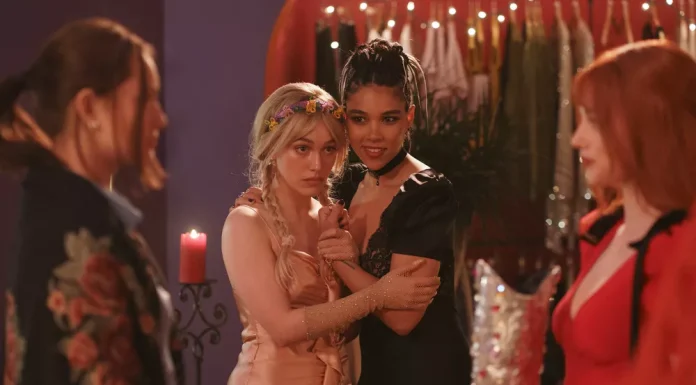
The story revolves around Apple, who works in a clothing store during the day and, in the evening, performs rituals with her friends in the basement of a shopping mall – their closed, almost sacred space. The arrival of newcomer Pumpkin upsets the fragile balance within the group: soon, the heroines’ friendship, which should be built on support and understanding, devolves into a power struggle, filled with intrigue and secrets.
The film “Forbidden Fruit” is an adaptation of Lily Haughton’s play, co-written with director Meredith Alloway. The project explores the toxic relationships within a female group, where each heroine chooses her own strategy—submission, manipulation, or conflict. The cast includes superstar actresses Lili Reinhart, Lola Thune, Victoria Pedretti, and Alexandra Shipp, who bring depth and emotional sincerity to the story. In cinemas from April 23rd.

READ ALSO: